
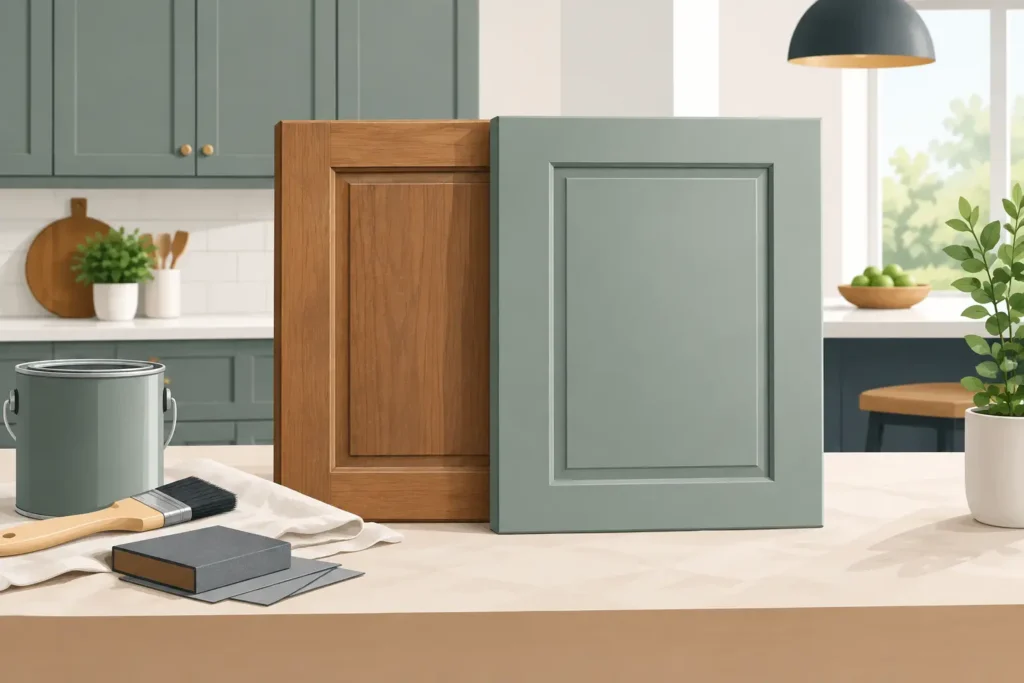
A kitchen can feel dated long before it stops working. Often, the cabinet doors are the reason: faded colours, worn edges, dated wood tones or a finish that no longer suits the rest of the home. Cabinet door refinishing offers a considered alternative to removing perfectly serviceable units, giving the kitchen a fresh, tailored appearance while retaining the layout you already know works.
For homeowners, landlords and property professionals, this is not simply a cosmetic update. A professionally sprayed finish can change the character of the entire room, from traditional oak-effect doors to a clean contemporary colour scheme, without the disruption of a full kitchen replacement.
What cabinet door refinishing involves
Professional cabinet door refinishing is a preparation-led process. The visible finish matters, but the lasting quality comes from the work completed before any colour is applied. Doors, drawer fronts and relevant fixed elements are assessed carefully, cleaned and prepared to create the right surface for the coating system.
Depending on the material and condition of the kitchen, preparation may involve degreasing, keying the existing finish, repairing minor surface imperfections and masking surrounding areas with precision. This stage is essential in kitchens, where surfaces are exposed to heat, moisture, cooking residue and everyday handling.
Once prepared, the doors are spray finished using premium coatings selected for kitchen use. Spray application creates an even, refined result that is difficult to achieve with brush-applied paint. It also allows the finish to sit smoothly across broad door faces, routed details, edges and panels, helping create the appearance of a newly manufactured kitchen.
The final result is not a cover-up for poor condition. A reputable specialist will be clear about what can be restored successfully and whether any damaged components need attention before refinishing begins.
Why restore cabinet doors rather than replace them?
Replacing a kitchen can involve removing units, worktops, plumbing connections, flooring sections and splashbacks. Even when only the doors feel outdated, the project can quickly become larger, more expensive and more disruptive than expected.
Cabinet door refinishing keeps the focus on the part of the kitchen that has the greatest visual impact. If the existing cabinets are structurally sound, well laid out and suitable for restoration, a new finish can make the whole space feel more current without unnecessary waste.
This approach is particularly valuable in properties where the kitchen footprint works well but the style does not. A warm cream finish can bring softness to a traditional room, while deep navy, sage green, charcoal or a bespoke neutral can introduce a more contemporary feel. The choice is not limited to standard off-the-shelf door ranges, either. Professional colour matching makes it possible to coordinate cabinet doors with walls, worktops, tiles or other interior finishes.
For rental properties, holiday accommodation and commercial settings, refinishing can also help refresh a tired kitchen between occupancies or during a planned update, with less upheaval than a complete refit.
Choosing the right colour and finish
Colour should be chosen in the context of the whole kitchen, not from a sample card alone. Natural light, artificial lighting, worktop colour, flooring and wall tones all influence how a cabinet colour will appear in the finished space.
Lighter shades can make compact or low-light kitchens feel more open, while richer colours can give larger rooms depth and definition. A two-tone scheme is another effective option: darker base units paired with lighter wall cabinets can ground the room without making it feel enclosed.
The sheen level matters just as much. A softer matt or satin finish tends to suit modern, understated kitchens, while a subtle sheen can bring definition to detailed doors and reflect more light. There is no single best option. The most successful choice balances the look you want with how the kitchen is used and maintained.
A consultation is useful here because colour decisions are rarely made in isolation. Viewing samples against the existing worktop, splashback and lighting gives a more reliable impression than choosing a colour online or in a showroom.
Is your kitchen suitable for refinishing?
Many kitchen doors can be professionally refinished, including previously painted doors and a range of manufactured surfaces. Suitability depends on the door material, its existing coating, the condition of edges and joints, and whether there is significant swelling, movement or impact damage.
Solid, stable doors with an intact structure are often strong candidates for restoration. Minor knocks, scratches and wear around handles may be addressed as part of the preparation process. However, doors with extensive moisture damage, delamination or badly compromised edges may require a different solution. Honest assessment is part of a quality service, because a premium finish needs a stable surface beneath it.
The same consideration applies to the fixed sections of the kitchen. Plinths, end panels, cornices and visible cabinet frames can often be refinished to create a consistent, complete look. Leaving these elements in an old colour can undermine the impact of newly sprayed doors.
The details that make a sprayed kitchen look exceptional
The difference between an average update and a convincing kitchen transformation is usually in the details. Handles are removed or carefully worked around, rather than treated as an afterthought. Hinges and drawer alignment are checked. Fine repairs are completed before spraying, and areas outside the work zone are protected thoroughly.
Professional spray finishing also avoids the heavy brush marks, roller texture and inconsistent coverage that can make a kitchen look painted rather than renewed. The objective is a smooth, durable surface with a consistent colour and sheen across every visible element.
Curing time is another consideration. A newly refinished surface needs appropriate time to settle before it faces the full demands of everyday kitchen use. Your specialist should explain aftercare clearly, including when doors can be handled normally and how to keep the finish looking its best over time.
Looking after refinished cabinet doors
Once the finish has cured, maintenance is straightforward. Wipe surfaces regularly with a soft cloth and mild, non-abrasive cleaner, particularly around handles, cooker areas and lower cabinets where splashes are common. Promptly remove cooking residue and avoid harsh scourers or aggressive chemical products that can dull any decorative surface.
Good ventilation also helps protect the wider kitchen environment. Extractor fans, sensible use of lids when cooking and wiping down moisture around sinks all reduce the build-up that can affect cabinets, worktops and walls over time.
A professionally refinished kitchen is designed for normal daily living, not for being treated as a showpiece. The key is sensible care, just as it would be with newly installed painted doors.
A tailored alternative to a full kitchen refit
Cabinet door refinishing is especially effective when you want a kitchen that feels personal rather than generic. You can retain quality cabinetry, improve the visual flow of the room and select a colour that suits your home instead of settling for a limited replacement range.
At Spray Granite Specialists, every project begins with understanding the existing surfaces, the desired finish and the demands the kitchen will face. With over 22 years of professional spray finishing experience, the focus is on meticulous preparation, premium materials and a result that feels considered from every angle.
If your cabinet doors are tired but the kitchen itself still works for your household or property, restoration may be the change that makes the room feel right again.